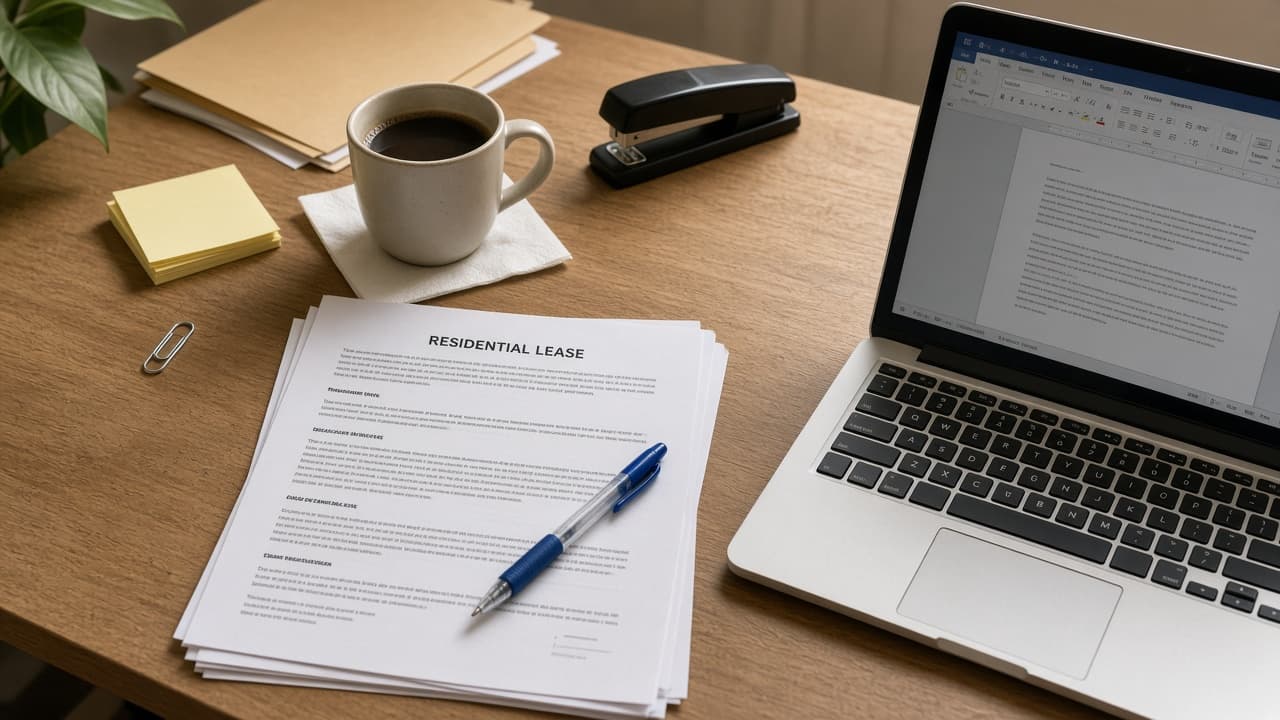
How Can AI Speed Up Lease Drafting and Review?
If you are asking "how can AI speed up lease drafting and review?", you do not need a button that "writes a legally binding lease." You need a clerk: fill blanks from a form you already own, compare this version to last year's, flag clauses that disappeared, and hand a human a punch list before anyone signs.
This guide is for property-management companies and self-managing owners. It is not a product review and not legal advice. Day-to-day AI jobs live in How Can Property Managers Use AI Day to Day?. The operating loop lives in How Do I Build an AI-First Property Management Workflow?. Copy-paste drafting language lives in Which ChatGPT Prompts Save Hours Every Week?. This post is the lease itself: first draft, comparison, review, renewal language, and the line where a model has to stop.
Educational only, not legal advice. Lease forms, notice periods, deposit rules, late fees, entry rights, and required disclosures vary by city and state. A fluent draft is not a legal document. Have a local housing attorney review the form you actually use. Never paste Social Security numbers, bank details, full credit files, driver's-license images, or extra identity documents into a general chat tool.
Quick answer: the model fills my form. It does not invent my law.
AI speeds up lease drafting and review when I already have a written, attorney-reviewed template for this market, I feed it only facts I can prove, I ask it to fill blanks and compare versions, and a person still checks every number, date, and required disclosure before the packet goes out.
No — if I ask a chatbot to "write me a California lease," auto-send a renewal, invent a late-fee clause, or tell me the draft is "fully compliant."
Renewal math still comes first. Before I draft new terms, I run the wait and the make-ready through the Lease Renewal vs Turnover Calculator so I am not letting a pretty paragraph decide a money question.
What do I mean by AI lease drafting and review?
I treat five jobs as five different risk levels. Vendors mix them on one invoice.
- Blank-fill from my form. The model copies rent, term, parking stall, pet deposit, and utility split into a template I already approved. Lowest risk if the output is a filled form, not a new form.
- Internal summary. A study sheet of parties, dates, rent, deposit, pets, utilities, entry, and renewal language. Medium risk. Useful if every missing section says "not in the pasted text."
- Version compare. Side-by-side of last year's lease vs this draft, or current lease vs a proposed renewal. Medium risk. The model is good at spotting a changed number and weak at knowing whether the change is legal.
- Addendum draft. A pet, parking, roommate, or appliance addendum from facts I paste, using the same defined terms as the base lease. Medium-high risk. I still attach it to the real form.
- "Write me a lease." A model that invents statutory language, notice periods, and disclosures. High risk. This is the product I do not use.
ChatGPT pasted a PDF is not a leasing attorney. A "lease generator" that will not show me the source form is still a guess with a letterhead. I stay liable either way.
If I have not chosen lease vs month-to-month yet, I start with Should I Use a Lease or Rental Agreement?. If I do not know which clauses my market actually requires, What State Lease Laws Could Hurt Me? and What Must I Put in My Lease Terms? are the paper process. The model sits on top of those, not instead of them.
Which lease jobs can AI actually finish faster?
The hours come from repetition, not from skipping review.
New lease from a locked house form. I keep one master for the city, with my parking, utility, and pet defaults already written. The model fills names, dates, rent, and unit identifiers. I read the filled fields. I do not let it rewrite the boiler.
Renewal packet after I pick the numbers. I decide rent and term on a spreadsheet. Then I ask the model to draft the cover note and a list of fields that change. The legal instrument is still my renewal form or a short amendment my attorney already blessed.
Addenda that keep showing up. Pets, extra parking, a roommate, a washer the owner is leaving. Same facts, same defined terms, same "this addendum controls if it conflicts" sentence I already use.
Internal file notes. A one-page summary for the unit folder so the next person on my team does not have to reread 18 pages to find the late-fee sentence.
Missing-clause checklist against my list. I paste my own checklist — smoke detectors, lead pamphlet, habitability, entry notice, insurance, utilities — and ask what is absent from this draft. I do not ask "is this legal in Texas."
What does not get faster: researching a new city's required disclosures, inventing a just-cause termination clause, or deciding whether a tenant's requested change is something I should accept.
If I am still picking a small software stack, Which AI Tools Should a Self-Managing Landlord Start With? is the starter kit. I hang leasing on the approved form, not on a new "AI lease" subscription.
How do I draft a first version without inventing the law?
I start with a form that already belongs in this jurisdiction: an attorney-reviewed house form, a local association form I am allowed to use, or the packet I used last year after a lawyer looked at it. Then I make a unit fact sheet.
The fact sheet is boring on purpose:
- Address, unit number, beds, baths
- Term start and end, or month-to-month
- Rent, due date, accepted payment methods
- Deposit amounts and what they cover
- Who pays which utilities
- Parking, storage, laundry
- Pet rule I actually enforce
- Occupancy limit I can defend
- Appliances that stay
- Any HOA or house rules I will attach
Then I wrap the job:
You are a drafting assistant for a landlord / property manager. Use only the attached form and the fact sheet. Fill blanks. Do not add clauses. Do not delete clauses. Do not invent notice periods, late fees, disclosures, or statutory language. If a fact is missing, ask me one question. Mark every filled blank so I can find it. End with a "needs my review" list of numbers and dates.
I read that list. I check the form against the fact sheet, not against the chat's confidence. If the model "helpfully" added a 3-day notice or a daily late penalty I did not paste, I throw the draft out.
Fair-housing language in the lease is the same problem as fair-housing language in the ad. Lifestyle words, "no kids," "perfect for a couple," and extra rules that only apply to families do not belong in either. Can AI Write Rental Listings That Actually Get Leads? is where I scrub ads. I scrub the lease packet the same way. Screening stays on a written standard, not in a secret lease clause — Is AI Tenant Screening Fair Housing Compliant? is that playbook.
When I am ready to collect signatures, I still follow How Do I Sign a Lease the Right Way?. The model does not witness anything.
How do I compare two leases or a renewal against the current one?
This is the job models are actually good at, and the job people skip when they are tired.
I paste last year's executed lease (or a text export) and this year's draft. I ask for a table: section, old language, new language, whether a number changed, whether a clause vanished. I tell it not to opine on "fairness" or "enforceability."
What I look for by hand after the table:
- Rent, due date, grace period, and late fee — did any number move without me noticing
- Term and notice to end or renew
- Deposit, last month, and pet amounts
- Who pays trash, water, HOA, and internet
- Entry notice
- Maintenance split and "tenant shall" chores that were not there last year
- Required local disclosures that dropped out of the PDF
- Addenda that were signed last year and never attached this year
A model will miss a scanned initial on page 9 and a checkbox that flipped. I still flip the pages.
For a renewal, I compare the current lease to the proposed terms before I send anything. If the only change is rent and end date, I say that in one sentence in the cover note. I do not bury a new early-termination fee in paragraph 14 and hope the model "summarized the highlights."
The summary prompt in Which ChatGPT Prompts Save Hours Every Week? is the study sheet. This compare step is the redline. Both stay internal until I send a packet I would take to court.
What should I never paste into a chat tool?
General chat tools are not my property-management system and not my lawyer's office. I paste the minimum.
Never as an input
- Social Security numbers, ITINs, or full bank account numbers
- Driver's-license or passport images
- Full credit, eviction, or criminal reports
- Wet-ink signature pages I do not need the model to see
- Other residents' personal data that is not required for this draft
- Prompts like "make this tenant-proof" or "add whatever protects me most"
Never as an output I accept
- A brand-new lease from a one-line prompt
- A claim that the draft "complies with state law"
- Auto-send to an e-sign tool
- A late-fee, notice, or deposit rule the form did not already contain
- Different terms for one household because the model thought they "sounded riskier"
If the task only needs the rent and the term, I do not paste the whole identity packet. How Do I Organize My Rental Records? is the filing habit. Chat history is not the executed lease.
When does a person or attorney still have to review?
Every outbound packet gets a human. Some packets also get a lawyer.
I always review
- Every filled blank
- Every number that moved
- Every addendum
- Tone and fair-housing language
- Whether the attachments list matches what I am actually sending
I send to a local housing attorney
- The first time I use a form in a city
- A clause I have never used (early termination fee, tenant-paid water, indoor smoking ban, short-term rental ban)
- A tenant-proposed redline I do not understand
- Anything that starts a legal clock: pay-or-quit, notice to vacate, change-of-terms that local law treats as a notice
- A portfolio that just crossed a local ordinance threshold (just-cause, rent cap, interest on deposits)
How Do I Find Rental Pros I Can Trust? is the hiring habit. Software will not invent a counselor who knows this zip code.
I do not let the model tell me the attorney is optional because the prose looks professional.
How do renewals and addenda fit the same workflow?
Renewal is a money decision wearing a Word document.
I do the money first. Empty days, make-ready, listing time, and the delta between current rent and what I could ask a new resident — that is the Lease Renewal vs Turnover Calculator. If I am changing rent, I sanity-check the increase with the Rent Increase Calculator. If I am tempted to "just turn it" because drafting feels like a chore, I look at the Vacancy Cost Calculator before I pick a fight with a good resident over a template.
Then I draft:
- Cover note: current rent, proposed rent, proposed term, deadline to reply, how to sign.
- The actual instrument: renewal form or amendment, not a chat essay.
- A one-line list of what changed, in plain English.
- Unchanged addenda attached again so they do not vanish.
Addenda use the same fact-sheet rule. A pet addendum names the animal the way the resident described it, the fee I actually charge, and the rule I already enforce. It does not invent breed bans I do not have, and it does not pretend an assistance animal is a pet.
After we sign, I still do the same move-in or continuation file. Hommy's Move-In / Move-Out Inspection Checklist is that layer for a new occupancy. The lease draft is over. The model does not get a second vote at key handover.
If I have not even listed the unit yet, What Should I Do Before Listing My Rental? is the terms work that happens before any AI draft.
What does a starter week of AI lease work look like?
I do not generate a lease on a Monday and send it on a Monday.
Day 1. Pull the form I am allowed to use in this city. If I do not have one, I stop and get one. I do not prompt my way around that.
Day 2. Write the unit fact sheet. One note per door. Numbers I can prove.
Day 3. Fill the form with AI. Export a PDF. Highlight every filled field. Fix the ones that are wrong.
Day 4. Compare against last year's executed packet. Attach the addenda that still apply. Scrub lifestyle language.
Day 5. If this is a renewal, run the Lease Renewal vs Turnover Calculator, then write the cover note. A person sends it. The week after, a person still files the signed PDF in the unit folder.
If I am mapping who owns leasing versus who owns the legal risk, What Does a Property Manager Do for Me? is the split. Software will not invent it.
What are the limits of AI on lease drafting and review?
It cannot know my city. Notice periods, deposit caps, required pamphlets, and rent-increase rules change. A national model lags.
It cannot be my form library. If I do not already own a lawful template, the chat is guessing in complete sentences.
It cannot witness or notarize. Signing is still How Do I Sign a Lease the Right Way?.
It cannot keep the executed copy. The unit folder is the record.
It cannot decide the renewal. Pretty language does not beat vacancy math.
It cannot be fair-housing review by itself. Same packet for every household. No extra hurdles in the fine print.
It cannot start a legal clock. Notices that count as legal process stay human, and usually attorney-shaped.
Use AI to fill, compare, and summarize. Use a person for every send. Use an attorney for the form and the weird clause. That split is the whole speed story.
FAQ
Can I let ChatGPT write a lease from scratch for a new state?
I do not. I get a local form first. Then I use the model as a clerk on that form.
Is an "AI lease generator" safer than filling my own template?
Usually the opposite. A template I can show a lawyer is something I can defend. A generated packet I cannot source is something I cannot explain when a clause is wrong.
Can I paste the full lease into a general chat tool?
I paste a text export or a copy with personal identifiers stripped when I only need a summary or a compare. I do not paste Social Security numbers, bank details, or identity images. I do not treat the chat as storage.
Can AI tell me if a tenant's redline is reasonable?
It can list what changed. I decide what I will accept. If I do not understand the change, I call the attorney, not the model.
What if the model dropped a required disclosure?
I assume it might. That is why I compare against last year's packet and against my own checklist, not against the model's "looks complete" line.
Where do Hommy's tools sit in this workflow?
Next to the decision, not instead of it. Renewal vs turnover before I draft new terms, rent increase when the number moves, vacancy cost when I am tempted to rush, move-in checklist after we sign. Open the landlord tools when I need a number or a written list. The model does not get the pen.
Final takeaway
I use AI on leases only as a clerk: fill the form I already own, compare this version to the last one, summarize for the file, draft the addendum from facts I pasted. Speed is real. So is the failure mode — a fluent, wrong late-fee sentence that I sent because it sounded like law.
The model can save me from a missed parking stall and a vanished pet addendum. It cannot save me from a "fully compliant" draft that never saw a local attorney.
When I am ready to decide whether this resident's next term is even the right money move, I open the Lease Renewal vs Turnover Calculator and I write the terms after the number, not before it.