Should I Repair or Improve My Rental Property?
You've purchased a rental property, and now you're facing a critical decision: Should you invest in repairs or improvements before renting it out? This choice can make or break your investment returns.
The difference between repairs and improvements isn't just semantic—it affects your budget, your timeline, your rental income potential, and your tax strategy. Understanding when to repair versus when to improve can help you maximize your investment while avoiding unnecessary expenses.
Repairs vs. Improvements: Understanding the Difference
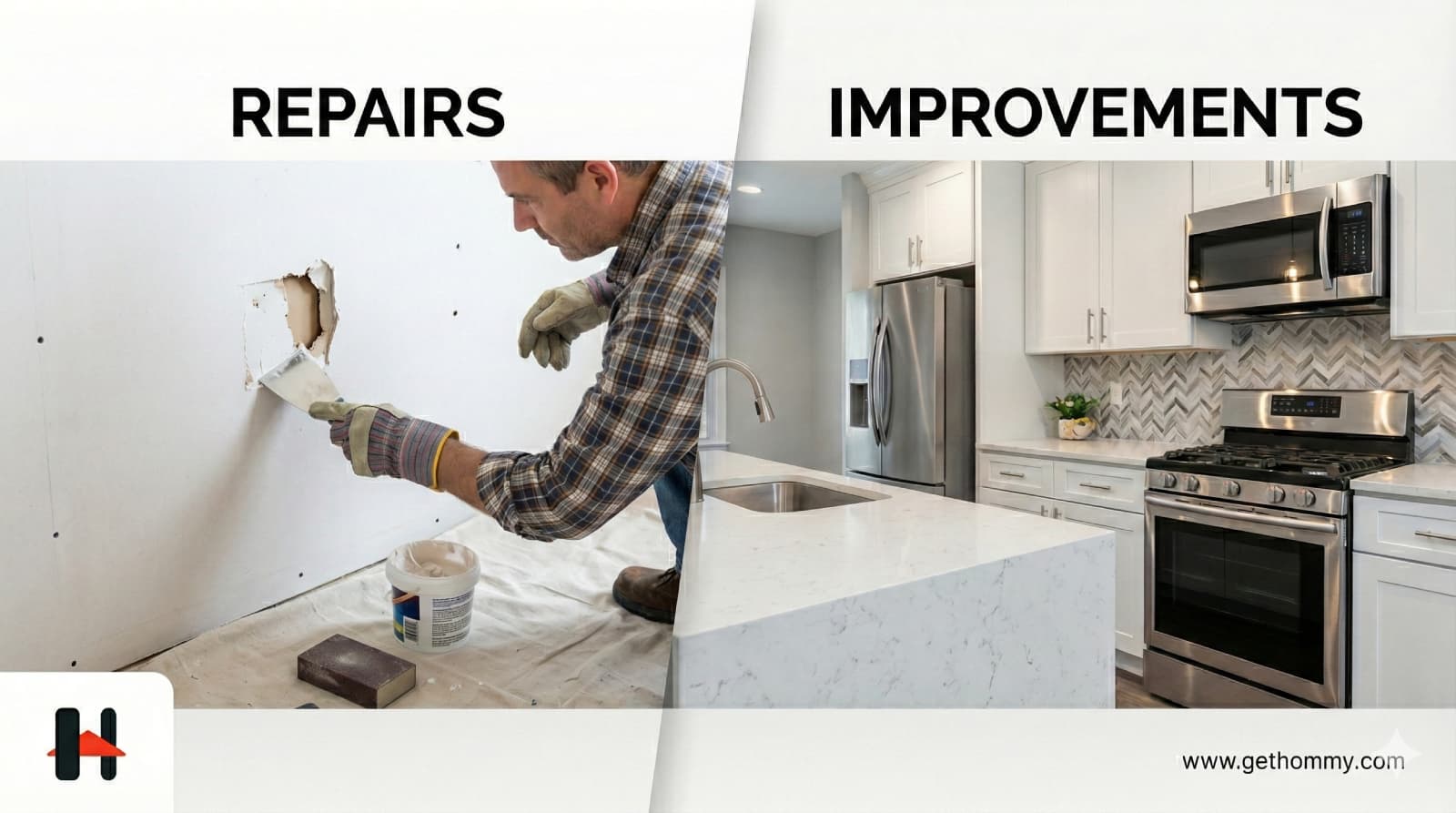
Repairs restore your property to its original condition or fix something that's broken. These are typically necessary for habitability and legal compliance.
Improvements enhance your property beyond its original condition, adding value or modernizing features that weren't there before.
The distinction matters because:
- Repairs are often required for legal compliance and tenant safety
- Improvements are typically optional and driven by market competition
- Repairs usually have immediate tax benefits (deductible in the year incurred)
- Improvements are capitalized and depreciated over time
- Repairs address existing problems, while improvements add new value
When Repairs Are Non-Negotiable
Some repairs aren't optional—they're legal requirements for renting your property. If your property has any of these issues, you must address them before a tenant can move in:
Critical Safety Repairs
- Structural damage that compromises the building's integrity
- Electrical hazards like faulty wiring, overloaded circuits, or missing GFCI outlets
- Plumbing failures that prevent basic functionality (no hot water, sewage backups)
- Roof leaks that cause water damage or mold
- HVAC systems that don't provide adequate heating or cooling
- Foundation issues that create safety hazards
- Missing or non-functional smoke detectors and carbon monoxide detectors
- Broken or missing handrails on stairs and porches
These aren't just "nice to have" fixes—they're required by housing codes and landlord-tenant laws. Renting a property with these issues exposes you to:
- Legal liability if tenants are injured
- Code violation fines
- Inability to collect rent if tenants withhold payment due to habitability issues
- Potential lawsuits
The Cost of Delaying Critical Repairs
Putting off necessary repairs often costs more in the long run. A small roof leak becomes extensive water damage. A minor electrical issue becomes a fire hazard. A small plumbing problem becomes a major emergency.
Address critical repairs immediately, even if it delays your rental timeline. The cost of fixing problems properly now is almost always less than the cost of emergency repairs later—plus the potential legal and financial consequences.
When to Consider Selling Instead of Repairing
Not every property makes sense as a rental investment. If your property needs extensive repairs, you need to do the math:
Calculate the True Cost
Add up:
- Purchase price
- Estimated repair costs (get multiple contractor quotes)
- Carrying costs during repairs (mortgage, insurance, taxes, utilities)
- Lost rental income during the repair period
- Contingency fund (add 20% for unexpected issues)
Compare this total to:
- The property's value after repairs (get a professional appraisal)
- Potential rental income (use our Rent Estimator)
- Your expected return on investment
Red Flags That Suggest Selling
Consider selling instead of renting if:
- Repair costs exceed 50% of the property's value—you're essentially rebuilding, not renovating
- The property needs months of work before it's rentable—carrying costs will eat into profits
- You don't have capital to fund necessary repairs—don't rent a property that doesn't meet basic standards
- The location or condition makes it unlikely to attract quality tenants even after repairs
- The numbers don't work—even after repairs, the property won't generate positive cash flow
Before committing to major repairs, run the numbers through our Cash Flow Calculator to see if the investment makes financial sense. If repairs would take the property from unprofitable to barely breaking even, selling might be the smarter move.
Strategic Improvements That Pay Off
Once your property meets all legal requirements, you can consider improvements that might increase rental income or reduce vacancy time. But not all improvements are created equal.
High-ROI Improvements for Rental Properties
These improvements typically offer the best returns for rental properties:
Kitchen Updates:
- New appliances (especially dishwashers in competitive markets)
- Updated countertops (quartz or granite)
- Fresh cabinets or cabinet refacing
- Modern backsplashes
Bathroom Renovations:
- New fixtures and faucets
- Updated tile
- Modern vanities
- Improved lighting
Cosmetic Updates:
- Fresh paint throughout (neutral colors)
- Updated flooring (hardwood, luxury vinyl, or quality carpet)
- Modern light fixtures
- Updated window coverings
Energy Efficiency:
- Energy-efficient windows
- Programmable thermostats
- LED lighting throughout
- Improved insulation
Outdoor Enhancements:
- Landscaping improvements
- Decks or patios
- Outdoor lighting
- Fencing
The Reality of Improvement Returns
Here's the truth: Most home improvements don't return 100% of their cost when you eventually sell. However, for rental properties, the calculation is different.
You're not just looking at resale value—you're looking at:
- Increased rental income (can you charge more rent?)
- Reduced vacancy time (will it rent faster?)
- Tenant quality (will it attract better tenants who stay longer?)
- Reduced maintenance (will newer features require less upkeep?)
Kitchen and bathroom remodels typically offer the best returns, but you're still unlikely to recoup every dollar spent. The key is whether the improvements help you achieve your rental goals.
Market Research Before Improving
Before spending money on improvements, research your local rental market:
What do competing properties offer?
- Visit similar rentals in your area
- Check online listings for amenities and features
- Talk to local property managers about market expectations
What are tenants willing to pay for?
- If all similar rentals have dishwashers, you might need one to stay competitive
- If your property already matches market standards, additional improvements may not justify the cost
- In some markets, basic functionality is enough; in others, modern amenities are expected
What's the rental price difference?
- If a $10,000 kitchen remodel only allows you to charge $50 more per month, it would take over 16 years to break even
- If the same remodel allows you to charge $200 more per month, you break even in about 4 years
Use our ROI Calculator to model how different improvements affect your investment returns over time.
The Improvement Decision Framework
Use this framework to decide whether an improvement makes sense:
Step 1: Is It Required for Compliance?
If yes → It's a repair, not an improvement. Do it.
Step 2: Does Your Property Already Meet Market Standards?
If yes → Skip the improvement unless it significantly increases rent or reduces vacancy.
Step 3: Will the Improvement Increase Rental Income?
Calculate:
- Additional monthly rent you can charge
- Months to break even (improvement cost ÷ additional monthly rent)
- Whether the improvement will reduce vacancy time
If the numbers work → Consider the improvement.
Step 4: Can You Afford It?
Even if the numbers work, ensure you have:
- Capital to fund the improvement without straining your finances
- Emergency reserves remaining after the improvement
- Ability to cover carrying costs if the improvement delays rental income
Step 5: Will It Attract Better Tenants?
Some improvements attract tenants who:
- Stay longer (reducing turnover costs)
- Take better care of the property (reducing maintenance)
- Pay rent on time (reducing collection issues)
These benefits are harder to quantify but can significantly impact your returns.
Common Improvement Mistakes to Avoid
Over-improving for the market: Installing luxury finishes in a basic rental market won't increase rent enough to justify the cost. Match your improvements to your market.
Under-improving in competitive markets: If all competing rentals have modern kitchens and yours doesn't, you'll struggle to find tenants even at lower rent.
Ignoring maintenance costs: A beautiful new deck requires ongoing maintenance. Factor in long-term costs, not just initial investment.
Improving before understanding the property: Live with the property (or rent it as-is first) to understand what actually needs improvement versus what you think needs improvement.
Not getting multiple quotes: Contractor prices vary widely. Get at least three quotes before committing to any improvement.
Working with Property Managers on Improvements
Professional property managers can be invaluable when deciding on improvements. They:
- Know your local market and what tenants actually want
- Have vendor relationships that can reduce improvement costs
- Understand what improvements reduce maintenance and tenant turnover
- Can coordinate improvements efficiently while minimizing vacancy time
If you're unsure about which improvements make sense, consider consulting with a property management company before making major decisions. Their market knowledge can save you from costly mistakes.
The Bottom Line
The decision between repairs and improvements comes down to:
- Repairs are required—do them before renting
- Improvements are optional—only do them if the numbers work
- Market research is essential—understand what your market expects
- Run the numbers—use calculators to model returns
- Don't over-improve—match improvements to your market, not your personal preferences
Remember: Your goal isn't to create your dream home—it's to create a profitable rental property that attracts quality tenants. Every dollar you spend should either be legally required or contribute to your investment returns.
Frequently Asked Questions
Should I repair or improve my rental property first?
Always repair first. Repairs are required for legal compliance and tenant safety. Improvements are optional and should only be considered after all necessary repairs are complete.
How much should I spend on improvements?
There's no one-size-fits-all answer, but most landlords spend 1-3% of the property's value on improvements. The key is ensuring improvements increase rental income or reduce vacancy enough to justify the cost.
Do improvements increase rental income?
Sometimes, but not always. Improvements only increase rental income if:
- They add value tenants are willing to pay for
- Your market supports higher rents for those features
- The improvement helps you compete with similar properties
Research your market before assuming improvements will increase rent.
Should I improve my rental property before the first tenant?
It depends. If improvements are needed to compete in your market, doing them before the first tenant can help you attract better tenants and charge higher rent. However, you might also learn what actually needs improvement after your first tenant moves out.
Can I deduct improvements on my taxes?
Improvements are capitalized and depreciated over time (typically 27.5 years for residential rental property), not deducted in the year you make them. Repairs, on the other hand, are typically deductible in the year incurred. Consult with a tax professional for advice specific to your situation.
How do I know if an improvement is worth it?
Calculate the return: Divide the improvement cost by the additional monthly rent you can charge. If it takes more than 5-7 years to break even, the improvement may not be worth it. Also consider whether it reduces vacancy time or attracts better tenants.
Ready to calculate whether repairs or improvements make financial sense for your property? Use our Cash Flow Calculator to model different scenarios, or get a Rent Estimate to understand what your property might rent for in your market.